

Key Takeaways:
User signals: Optimizing for Dwell Time and CTR impacts your long-term rankings.
On-page SEO is one of the foundational pillars of digital marketing success — see how it integrates with PPC, content marketing, and social media in our introduction to digital marketing.
On-Page SEO is evolving: It’s no longer just about keywords; it’s about satisfying Search Intent and demonstrating E-E-A-T.
Technical foundation matters: Core Web Vitals and mobile-friendliness are now critical on-page factors.
Structure is key: Proper use of H1-H6 tags, Schema Markup, and logical URL structures helps Google understand your content.
Content depth wins: Comprehensive coverage of a topic (using Semantic SEO) outperforms keyword stuffing.
In this guide, we will start with SEO basics and then move into the depth of On Page Optimization(On-Page SEO).
Google gets 34% of World’s Organic Traffic (Pollthepeople).
This guide will tell us everything we can do in page SEO to increase ranking in SERPs organically.
After reading the complete article you’ll know everything about how to do SEO on pages of your websites.
Let’s Start with SEO Basics
SEO means Search Engine Optimization.
Search Engine Optimization means amendments or changes made on some parts of your website in order to increase search engine ranking organically.
Optimization of Search Engines can be done mainly in three ways – On-Page SEO, Off-Page SEO, and Technical SEO.
These are some SEO basics and if you want to learn more you can read our “what is SEO” Blog made for beginners.
What is On-Page SEO?
On-Page SEO (also known as on-site SEO) is the practice of optimizing web page content for search engines and users. Common on-page SEO practices include optimizing title tags, content, internal links, and URLs.
Unlike Off-Page SEO, which involves external signals like backlinks, On-Page SEO is completely within your control. It is the foundation upon which your digital marketing strategy is built. If your on-page signals are weak, even the best backlink profile won’t save you.
By doing modifications it will help in increasing the blog ranking and visibility of websites in search engine result pages.
This optimization of search engines is done on web pages and on their content that’s why it is called On-Page SEO.
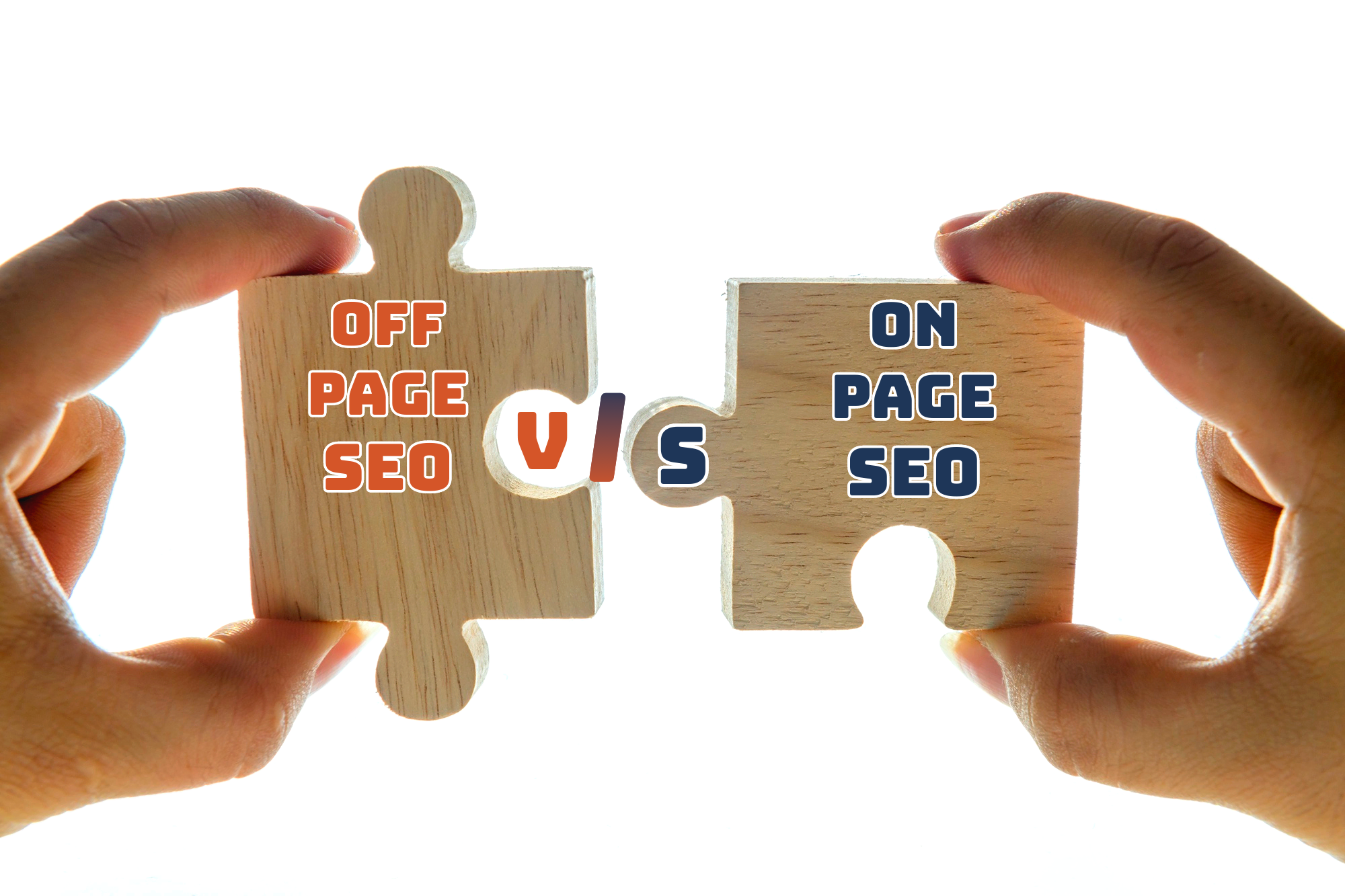
On-Page vs. Off-Page SEO: The Breakdown
| Feature | On-Page SEO | Off-Page SEO |
| Focus | Internal (On the page) | External (Off the page) |
| Control | 100% Control | Indirect Control |
| Primary Goal | Relevance & User Experience | Authority & Trust |
| Examples | Content, Meta Tags, Core Web Vitals | Backlinks, Social Signals, Brand Mentions |
In On-Page SEO every modification is done internally or on the web pages whereas In Off-Page SEO modifications are done externally or outside of web pages.
Internal links, tags, content modifications, and all on page optimizations that lead to SEO on pages are examples of On-Page SEO.
Backlinks, Social Media, Reviews, and Online answers on sites like Quora are the best examples of Off-Page SEO.
| On-Page SEO | Off-Page SEO |
|---|---|
| 1. On-Page SEO is done on the web pages or internally on pages. | 1. Off-Page SEO is done off web pages or externally. |
| 2. On-Page SEO is also known as On-Site SEO. | 2. Off-Page SEO is also known as Off-Site SEO. |
| 3. Analysis and modifications of the complete page are done in On-Page SEO. | 3. In Off-Page SEO promotion of websites is done externally. |
| 4. In On-Page SEO Internal linking is used. | 4. In Off-Page SEO backlinks are used. |
| 5. Example – URL optimization, Tags optimizations, Internal and external links, Image optimization, Content Optimization, etc. | 5. Example – Guest Blogging, Social Media Engagement, Backlinks, Influencer outreach, etc. |
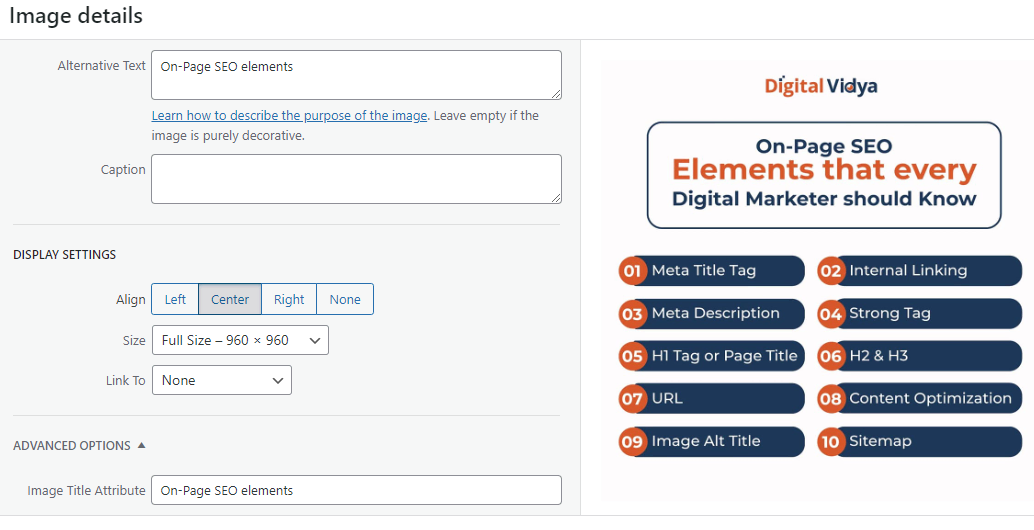
On-Page SEO Elements That Every Digital Marketer Should know
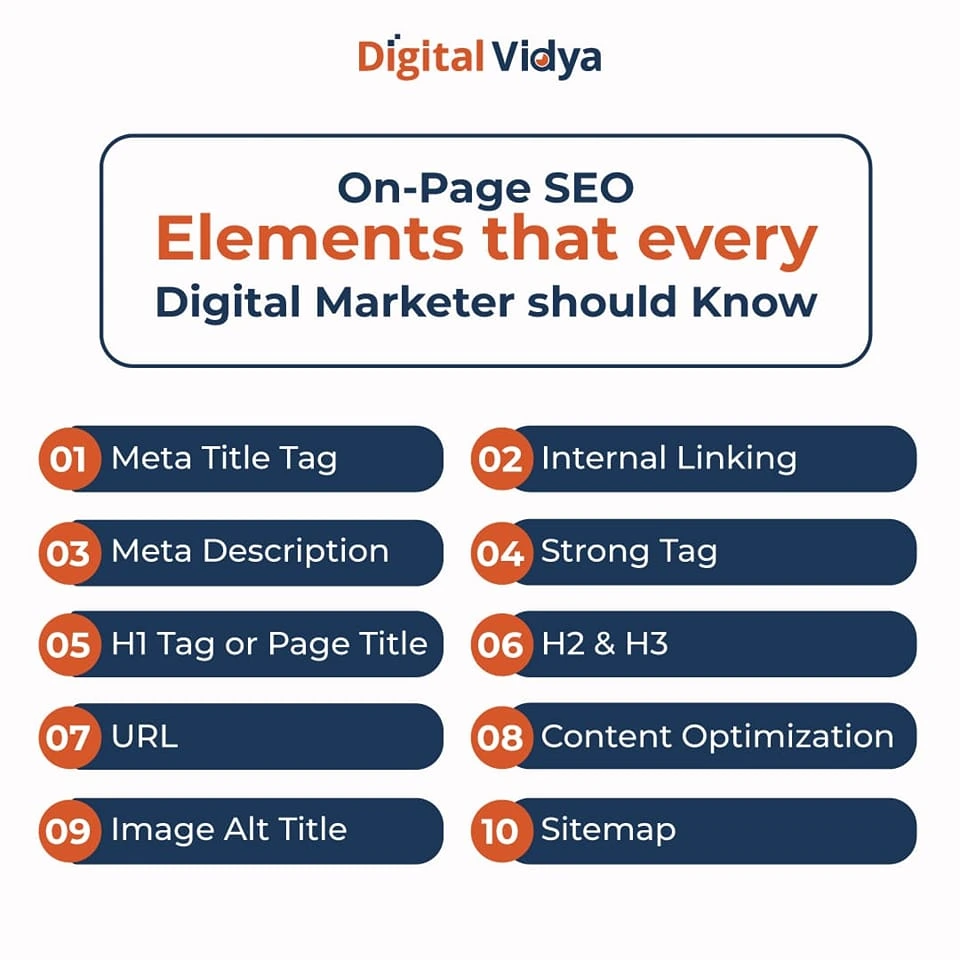
These are some SEO elements that every SEO expert and digital marketer should know. Without these elements, proper on-page optimization cannot be done.
There are some other on-page elements but the 10 elements mentioned here hold high importance. They will help in increasing site rank organically if you follow these elements in your site.
1. Meta Title Tag in On-Page SEO
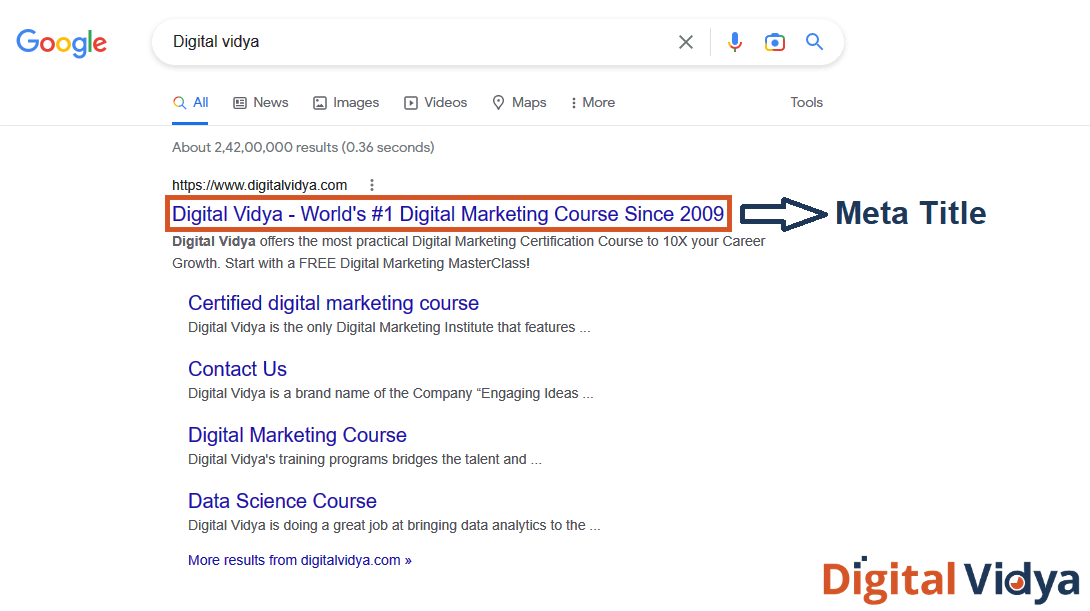
An HTML tag by which browsers and search engines get to know about the content of a webpage is known as Meta Title.
Few tips while writing Meta title in On page SEO:
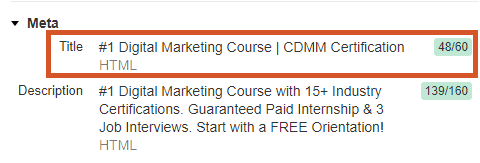
- Meta Title Character limit: The meta title ideal character limit is between 50 to 60 Characters and if more than 60 then Google will cut the title in SERPs.
- Use Target Keyword: Target Keyword should be used in our Meta Title so that Users and Search Engines can know what is the content of the webpage.
- Unique Title: The meta Title should be unique for every page so that Search Engines can be clear about the blog content.
- Avoid using Underscore: Avoid using underscore in place of spaces in meta titles, it’s better to use Hyphen “-” as Google takes Hyphen as a word separator.
2. Internal Linking in On-Page SEO
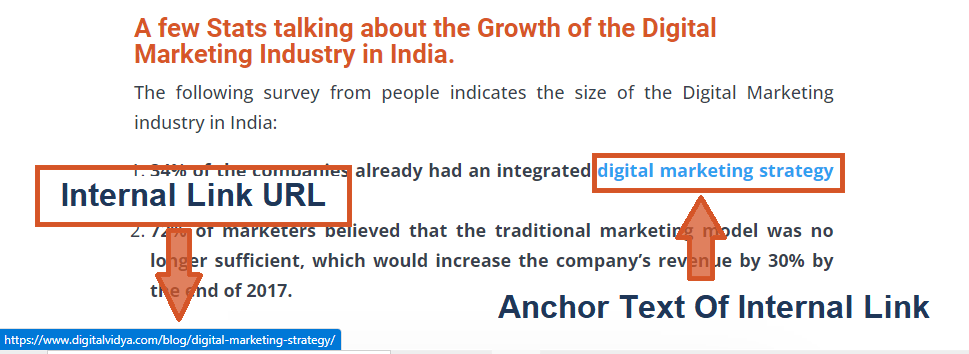
Hyperlinks for different pages of the same website are known as Internal Links and the process of doing that is known as Internal Linking.
Why is Internal Linking Important in On-Page SEO?
Internal Linking is important in On-Page SEO because of the following reasons –
- It helps search engines in understanding the overall structure of your website and also helps in checking page relevancy.
- Internal links help search engines for crawling and discover new pages.
- Your website will get a better ranking if the linked page is related to user search intent.
- Internal links will help your audiences to increase engagement and navigate through your website for a longer period of time.
3. Meta Description in On-Page SEO
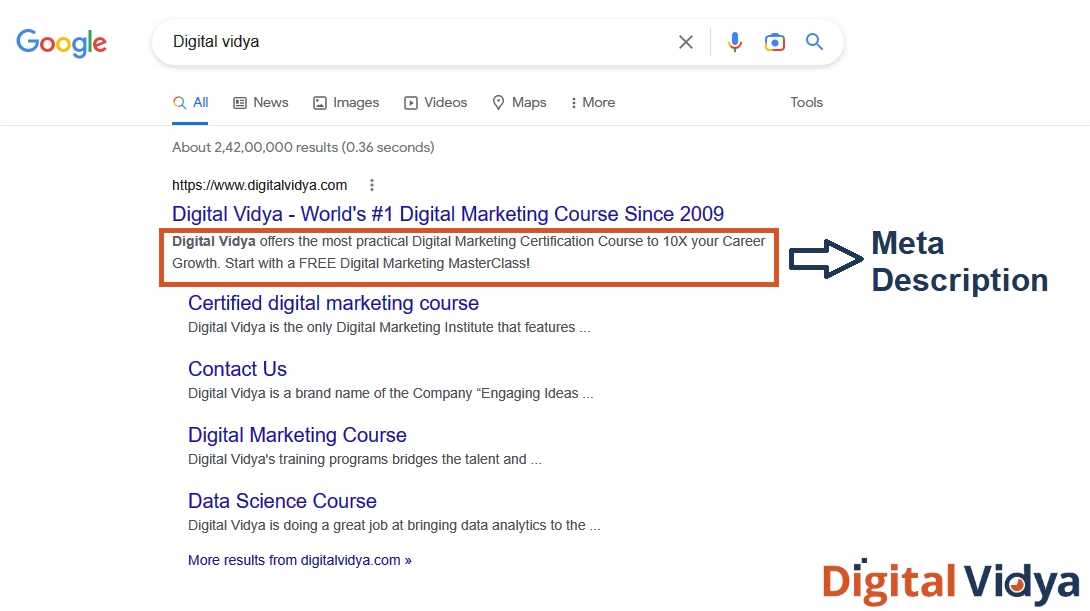
An HTML element that is used to describe the content of a page to users and search engines is known as Meta Description.
Few Tips for writing Convincing Meta Description
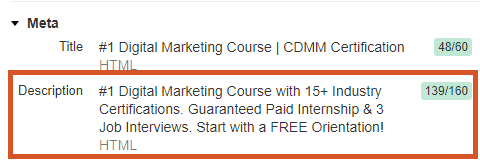
- Character Limit: Ideal Character limit for writing a convincing Meta Description is 140-160 characters after that Google will truncate your description.
- Target Keyword should be used at least once in Meta Description: Meta Description is highlighted by the search engine if the search query matched the target keyword.
- Active voice is preferred: If using active voice then it will save lots of space in the meta description and explain the description more clearly.
- Use Eye catching phrases: Use convincing phrases like “offer ending soon”, “learn more”, “click here to know more” etc. to increase chances of getting more clicks by users.
4. Strong Tag use in On-Page SEO
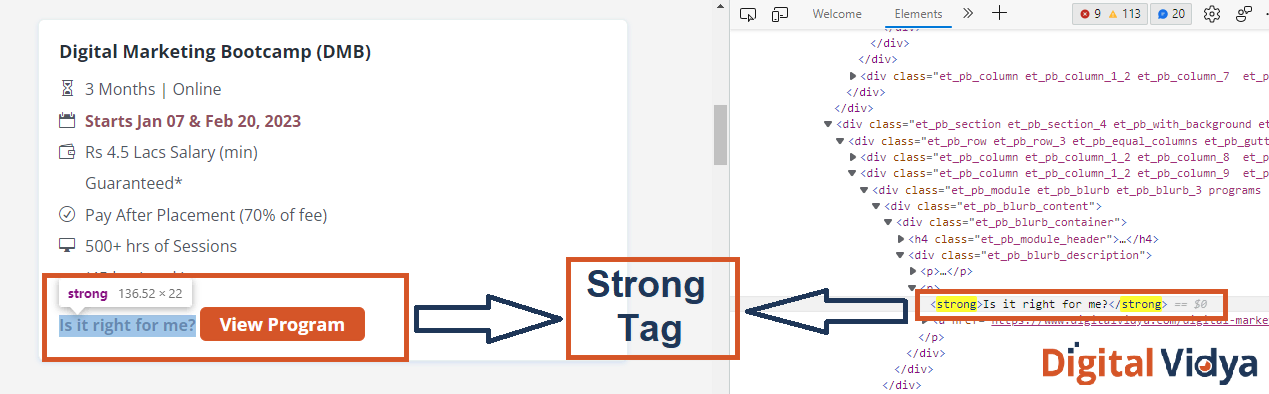
A word, sentence, or any section with high importance should be marked with a “Strong” HTML tag by which the text will be highlighted in bold.
It will help the search engines in knowing that this section in the strong tag is of higher importance.
Example: Strong tag should be used like this for better on-page search engine optimization.
“<strong>Some important text</strong>”
5. H1 Tag or Page Title in On-Page SEO

The heading or title shown at the top of any webpage is known as Page Title. A page title is also known as Blog Title.
H1 HTML tag is used for denoting the main page title and other header tags are used for denoting subheadings.
H1 Main header tag starts with <h1> and closes with </h2> as shown in the above image.
Few tips for writing Eye Catching Page Title or Blog Title

- The page title should contain the target keyword which you are using for the article.
- Try to use page titles according to URL structure and meta titles to maintain relevancy for users and search engines.
- The page title should not be long, recommended length is around 60 characters.
- The target keyword should not be stuffed in the title it should be used once after every 100 words.
6. H2 to H6 Subheading Tags in On-Page SEO
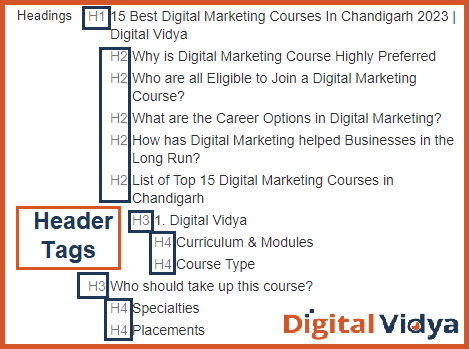
Header tags (H1, H2, H3, H4, H5, and H6) are some of the elements of HTML used to denote headings and subheadings on a page of a website.
Here H1 denotes the Main header tag used mainly for the main title or page title which should be used for top most heading on a page.
Other header tags from h2 to h6 are used for denoting subheadings on a page.
h2 and other subheading tags start with <h2> and close with </h2> as shown in the above image.
Tips for using Subheading tags in On-Page SEO

- The target keywords should be used at least once in subheadings.
- Subheadings tell the search engines and users in understanding that this section is part of its heading to maintain relevance with its heading contents.
- Subheadings make easy navigation for users as it divides the long section of content into various parts which make the content reading simpler and easier.
7. SEO Friendly URL Structure

URL means Uniform Resource Locator and it is a web address used to go on any website. In the above image, one of our website’s URLs is mentioned.
Tips for SEO Friendly URL structure:
- The URL should contain the target or focus keyword.
- The URL length should be simple and short so that users can understand it easily.
- Spaces should not be used in URL, in place of spaces we can use Hyphen “-”.
- Avoid using special symbols in URLs.
8. Content Optimization: Mastering Search Intent & Semantics
The days of repeating a keyword every 100 words are over. Modern On-Page SEO focuses on Semantic SEO—helping Google understand the meaning and context of your page.
How do I optimize content for Search Intent?
Before writing a single word, Google your target keyword. Analyze the top 3 results to determine the user’s goal:
- Informational: Are they looking for a guide? (e.g., “What is SEO”)
- Transactional: Are they ready to buy? (e.g., “Buy SEO Audit Tool”)
- Comparative: Are they weighing options? (e.g., “Semrush vs Ahrefs”)
Actionable Tip: If the top results are detailed “How-to” guides, do not write a short product page. Match the format and depth of the ranking content.
Integrating LSI Keywords & Entities
Google uses Natural Language Processing (NLP) to identify entities (people, places, concepts). To rank, your content must cover the “Main Entity” (your topic) and “Related Entities” (concepts naturally associated with it).
Use Tools: Use tools like Google’s “People Also Ask” or Semrush to find these related terms.
Don’t just use synonyms. If you are writing about “On-Page SEO,” naturally discuss Meta Tags, HTML Header, Crawl Budget, and User Experience.
Optimization of pages should be done using SEO techniques and in on-page SEO content, optimization plays a vital role.
In Content Optimization, you should focus purely on the content of your article rather than other technical optimizations.
Some tips for Good Content Writing in On Page SEO:
- Good content writing should have high-quality content other than false or confusing content.
- Use header tags wisely in the whole content like using h1 for the main heading and other header tags for subheadings.
- Paragraphs should not be long else user interaction will decrease and may result in bounce back to other websites
- Use optimized and relevant good-quality images in the content.
- Before writing content proper keyword research and exploration of the topic should be done first.
- Focus on a single theme throughout the content else multiple themes will make the reader confused.
- Use eye-catching fonts and designs but it should not be much else it will increase the loading speed of the site.
9. Image Optimization in On-Page SEO
The process of optimizing images in webpages to increase the search engine ranking is known as Image optimization.
Image optimization is done so that the audience does not get bored with the lack of good-quality optimized images.
Some tips for Good image optimization
- The images should have proper alt, title, and caption so that users and search engines can know what the image is about.
- Images should be good quality because blurry images make the audience angry and may increase the bounce rate.
- The image should not take much storage else it will increase the loading speed of the site.
- An image should be relevant to its heading and its content in the paragraph.
- Maintain the contrast of images else poor contrast also increases the bounce rate.
10. Use of Sitemap in On-Page SEO
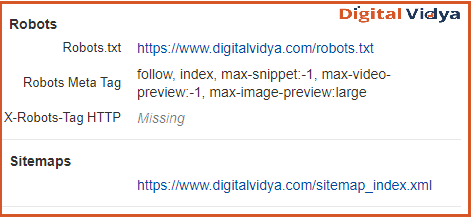
A sitemap is information about the content of your website which tells the search engines about the various pages, their content, and what is the relation between them.
Like every page may have different content like videos, and textual posts so sitemaps tell everything to search engines. It becomes easier for search engines to crawl and index the pages more efficiently.
So we should keep updating and submitting the sitemaps after every modification in sites for better indexing and better ranking. Sitemaps is an XML file.
If you don’t want a page to be crawled and indexed then mention it in “noindex” tag and if you want to stop link juice from passing then use “nofollow” tag.
11. HTML Tags: The Skeleton of Your Page
HTML tags communicate specific hierarchy and relevance signals to search engine crawlers.
How to write the perfect Title Tag?
Your title tag is the single most important on-page SEO factor.
- Front-load your keyword: Place your main keyword at the beginning.
- Keep it under 60 characters: Prevent truncation in SERPs.
- Add a hook: Use power words (e.g., “Definitive,” “Guide,” “Fast”) to boost CTR.
Why are Header Tags (H1-H6) important?
Headers provide structure.
- H1: Your main headline. Must contain your primary keyword. Use only one H1 per page.
- H2: Major subheadings. Use these to target long-tail keywords (e.g., “How to fix broken links”).
- H3: Detailed sub-sections.
Pro Tip: Write H2s that look like questions found in the “People Also Ask” box. This increases your chances of capturing Voice Search traffic.
Meta Descriptions: The Ad Copy
While not a direct ranking factor, a compelling Meta Description improves your Click-Through Rate (CTR).
- Length: Keep it between 140-160 characters.
- Call to Action: Encourage the click (e.g., “Read the full guide,” “Download the checklist”).
12. Technical On-Page SEO: Speed & Structure
Technical health ensures that your great content can actually be indexed and enjoyed.
What are Core Web Vitals?
Google now uses Core Web Vitals as a ranking signal. These metrics measure real-world user experience:
- Largest Contentful Paint (LCP): Loading performance (Target: < 2.5 sec).
- First Input Delay (FID): Interactivity (Target: < 100 ms).
- Cumulative Layout Shift (CLS): Visual stability (Target: < 0.1).
URL Structure Best Practices
- Short & Descriptive:
domain.com/on-page-seois better thandomain.com/category/2025/blog/id=123. - Use Hyphens: Always separate words with hyphens (-), never underscores (_).
- Avoid Dates: Keeping dates out of URLs makes it easier to update content later without redirecting.
13. Advanced On-Page Signals: E-E-A-T & Schema
Demonstrating E-E-A-T
Google’s quality raters look for Experience, Expertise, Authoritativeness, and Trustworthiness.
- Author Bios: clearly state who wrote the article and their credentials.
- External Linking: Link to reputable sources (gov, edu, or industry leaders) to back up your claims.
- Accuracy: Update statistics and facts regularly.
Using Schema Markup (Structured Data)
Schema is code that helps search engines understand your content type (e.g., Recipe, Review, FAQ, Article).
- Benefits: It powers Rich Snippets (star ratings, images, FAQ boxes) in search results, which can double your CTR.
- How to add: Use a plugin or Google’s Structured Data Markup Helper.
14. Media Optimization: Video
Video SEO
Video make content engaging but can slow down your site if ignored.
- Alt Text: Describe the video using your keyword naturally (for accessibility and SEO).
- File Names: Rename video as
on-page-seo-checklistvs generic name
Few tips for On-Page SEO
The usage of original images is the top recommendation. In cases you have been nurturing your page with stock images, drop them right away.
Writers who initiate with original images instead of stock images for their page potentially have better scores in comparison.
LSI keyword is the third way to grow your on-page SEO blogs. These are what google would use to evaluate the relevancy of your page.
Especially for short content, you need to pay serious attention to LSI keywords. On the long ones, having the LSI keyword somewhere around comes normally.
To find out whether your blogs have the LSI keyword, google your keyword, find the ”searches related to..” and eye on anything related to your post.
The loading speed of a page gives a bonus to the SEO ranking. This information is given by Google which asserts the loading speed as the SEO ranking signal.
Today Page Speed has become one of the most important on-page SEO factors that determine a page’s success.
For a better loading speed, shift to a better and faster host. Doing so shall be enough for the improved speed.
But for some more good results, eliminate the third-party scripts. The more they are absent, the better it is for the loading speed. Third-party scripts reduce the total size of the page and also unfavorably affect the page load times.
With many on-page SEO techniques, the tips mentioned above will help you out with the on-page SEO page you’ve been dreaming of.
Conclusion
On a concluding note, we hope you would have understood what on-page SEO is and how it plays a key role in optimizing the online presence of websites in SERPs.
In case you want to learn SEO more comprehensively, and become a certified SEO expert, enroll in the most updated SEO course now.
Does On-Page SEO still matter in 2026?
Absolutely. While AI and algorithms change, the need for Google to understand your content’s relevance through on-page signals (content, tags, structure) remains the primary way rankings are determined.
How often should I update my old blog posts?
You should audit your content every 6-12 months. Update outdated statistics, check for broken links, and add new sections to cover emerging sub-topics (like “AI in SEO”). Freshness is a ranking factor.
What is the difference between H1 and Title Tag?
The Title Tag appears in the search engine results (SERPs) and browser tab. The H1 Tag is the headline users see on the actual page. They should be similar but don’t need to be identical.
Can I use the same keyword on multiple pages?
Avoid this. It causes Keyword Cannibalization, where your own pages compete against each other. Each page should target a unique primary keyword and intent.
How does internal linking help On-Page SEO?
Internal links distribute “link equity” (authority) from high-performing pages to new ones. They also help Google crawl your site and understand the semantic relationship between your topics (Topic Clusters).







This is an informative post. Got a lot of info and details from here. Thank you for sharing this and looking forward to reading more of your post.
wonderful contents .keep uploading more goodluck !
Thanks for sharing this blog detailed information about on page seo.
This is great and tremendous post
Keep Sharing
BEST BLOG EVER
Very useful, thanks for sharing ?
Hey, your blog was very helpful in many ways, thank you for letting us know about.
You’re Welcome.